
16/06/2026


Global trends in chemical industry development and Vietnam's orientation.
Date 16-12-2025 Views 515
The global chemical industry is shifting to developing countries, opening up opportunities for Vietnam to break through and build a modern and self-reliant chemical industry.
Vietnam becomes an attractive destination for the chemical industry
In Vietnam, the chemical industry has been established since the 1950s-1960s, starting with fertilizer and consumer chemical factories in the North supported by the Soviet Union and China to meet the demand for fertilizers and some other chemicals are essential for life.
From its inception, the Party and State have issued many policies and guidelines to promote the development of the chemical industry. Thanks to this, along with the process of industrialization and modernization of the country, the Vietnamese chemical industry has made significant progress. Currently, there are about 2,000 enterprises operating in the chemical sector nationwide. The total annual output of the Vietnamese chemical industry accounts for about 10-11% of the total GDP of the industrial sector, and the total output value of the chemical industry accounts for 13-14% of the entire industrial sector. The development of the chemical industry contributes to enhancing domestic production capacity, gradually reducing dependence on imports, and progressively participating in the global value chain.
In recent years, the chemical industry has made a positive contribution to Vietnam's economic development. Specifically, in the period 2022-2025, the chemical industry attracted 27 outstanding projects with a total capital of nearly 100,000 billion VND, ranging from: technical rubber production; electrochemical power sources (batteries); basic chemicals, petrochemicals; industrial gases, to high-quality fertilizers.
In recent years, the general trend of the global chemical industry has been to shift production plants to developing countries. Many international corporations such as AGC (Japan) and Donggang (China) have come to survey investment opportunities in large-scale chemical complexes. This shows that Vietnam is becoming an attractive destination on the regional chemical investment map.
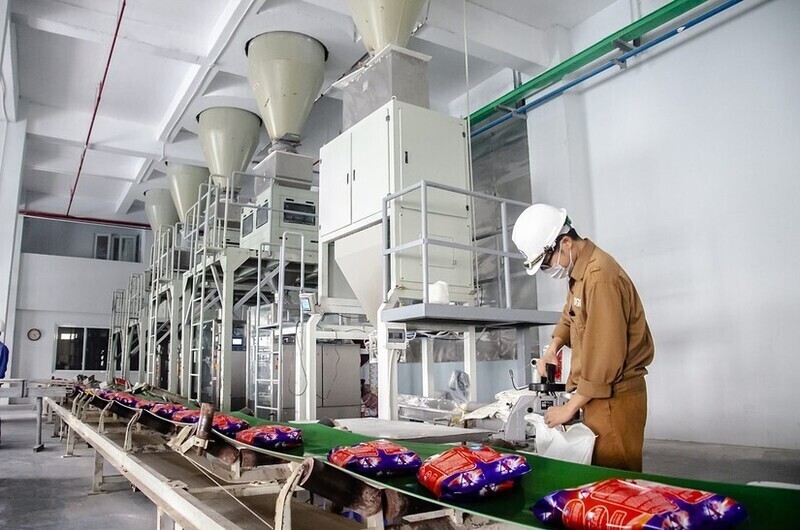
During the period 2022-2025, the chemical industry attracted 27 outstanding projects with a total investment of nearly 100,000 billion VND. (Illustrative image)
Currently, Vietnam has established several chemical industrial parks and complexes in localities such as Ba Ria - Vung Tau, Phu Tho, Thai Nguyen, Thanh Hoa, etc. Many provinces and cities have also proactively included specialized chemical industrial parks in their planning, reflecting a clear shift in the perception of the industry's role.
These industrial parks are oriented towards modern development, ensuring safety, linked to the circular economy, and effectively exploiting the advantages of seaports and logistics. Although Vietnam still imports more chemicals than it imports, domestic products have begun to improve in quality and variety. This is the foundation for gradually reducing import dependence in the future.
Strategic steps to build a breakthrough chemical industry.
The socio-economic development strategy 2021-2030 emphasizes the development of fundamental industries such as energy, metallurgy, mechanical engineering, and chemicals, while promoting a green economy and circular economy. Resolution 29-NQ/TW of the Central Committee of the Communist Party of Vietnam on continuing to promote industrialization and modernization of the country until 2030, with a vision to 2045, also emphasizes prioritizing the development of basic chemicals, petrochemicals, pharmaceuticals, and fertilizers.
In particular, the Strategy for the Development of the Chemical Industry until 2030, with a vision to 2040, as outlined in Decision 726/QD-TTg of the Prime Minister, is an important step, creating a legal framework for the chemical industry to develop in a modern and sustainable manner. These orientations clearly demonstrate the determination of the Party and the State in building a self-reliant, green, and high-tech chemical industry.
According to the Chemical Department (Ministry of Industry and Trade), the Government's Strategy for the Development of the Chemical Industry until 2030, with a vision to 2040, is an important step, creating a legal framework for the chemical industry to develop in a modern and sustainable manner. These directions clearly demonstrate the Party and State's determination to build a self-reliant, green, and high-tech chemical industry.
The Chemical Department further informed that the industry currently employs approximately 2.7 million workers, equivalent to 10% of the total industrial workforce nationwide. Notably, labor productivity in this sector is 1.36 times higher than the average for the entire industrial sector, thus affirming the increasingly improved professional skills and quality of human resources.
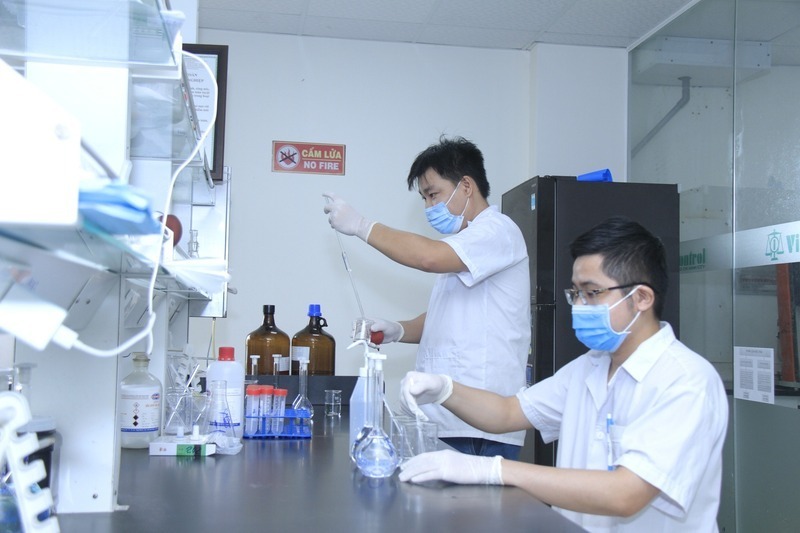
The industry currently employs approximately 2.7 million workers, equivalent to 10% of the total industrial workforce nationwide. (Illustrative image)
From a long-term development perspective, chemicals play a crucial role in the country's industrialization and modernization process because they are present in almost all areas of life, from agriculture, industry, processing, textiles and footwear, construction materials to healthcare and high technology.
Many experts also share the opinion that without the chemical industry, there would be no other industry.This further demonstrates the central role of human resources in the chemical industry in ensuring the operation of a wide range of sectors, from fertilizers, petrochemicals, basic chemicals, paints, printing inks, industrial gases to cosmetics and pharmaceuticals.
To make the chemical industry truly a pillar of the economy, in 2025 the National Assembly enacted the amended Chemical Law, which will take effect from January 1, 2026. The 2025 Chemical Law for the first time clearly defines key chemical industry sectors such as: basic chemicals, petrochemicals, pharmaceuticals, high-quality fertilizers, hydrogen production, green ammonia, specialized chemical industrial parks, and large-scale chemical complexes.
To ensure chemical safety and security, the Chemical Law also requires projects to develop a chemical incident prevention and response plan from the investment preparation stage. It also requires compliance with safety distance planning when site layout. Feasibility study reports must fully demonstrate safety solutions. These are mandatory regulations to ensure the sustainable development and safety of the chemical industry for the community.
In addition, promoting green transformation, circular economy, and digital transformation, the Chemical Law has included requirements for: selecting technologies that efficiently utilize resources, reducing the use of hazardous chemicals, reducing waste, designing production according to green chemistry principles, and applying digital transformation in corporate governance and state management. This is an inevitable trend of the global chemical industry and opens up opportunities for the Vietnamese chemical industry to develop strongly in the new era.
To ensure the chemical industry truly becomes a pillar of the economy, in 2025 the National Assembly enacted the amended Chemical Law, which came into effect on January 1, 2026. The 2025 Chemical Law for the first time clearly defines key chemical industry sectors such as: basic chemicals, petrochemicals, pharmaceuticals, high-quality fertilizers, hydrogen production, green ammonia, specialized chemical industrial zones, and large-scale chemical complexes.
Source: Quoted from the Industry and Trade Newspaper


Tin liên quan


